THE WINTER READING

Reading is a wonderful pastime. It is a hobby that transports the reader to different places. Readers can meet different people in different time zones or eras.

There are few aspects of reading that I follow consistently. I would like to share the same here.

  • Reading outside early morning undisturbed helps – helps one to unwind and start the day in a very relaxed manner.
  • Read books that are not connected to one’s area of specialization. I am an Economics teacher by profession, but I read a lot about History, Literature, Geography and Philosophy.
  • Make sure one does not read more than 10 pages a day. Reading should be followed by reflection too.
  • Read different books each day. If one reads a biography today, read a literature book tomorrow.
  • Read one fiction a month – it be romance, thriller or a murder mystery.
  • Treat vacations as an opportunity to read.

I travel to different locations, find places to rest and read regularly. This winter vacation I read:

  • Agatha Christie: Closed Casket by Sophie Hannah.

This was an unfinished murder mystery by Agatha Christie, which was completed by the Author Sophie Hannah. Unlike the earlier mysteries, this book does not have the thrill nor was it gripping. The twist and the turns were pretty predictable. Hercule Poirot was not characterized as expected. The character seems to talk a lot and hardly uses French during his exclamations. Yet, the English County and their everyday rituals are well described.

  • How To Become CEO. An Amazon.com Top 10 Business Book. The Rules for rising to the top of any organization by Jeffrey J. Fox.
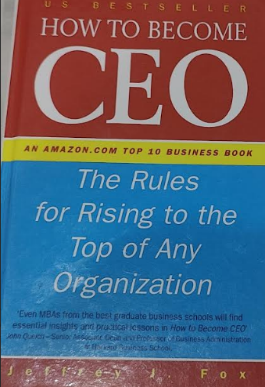
This was a good book to read – short, sweet and crisp. This book is practical and provides tips to handle workplace conflicts. It guides on navigating one’s career using simple but effective strategies. This book is an ideal gift for a BBA or MBA student. The suggestions also help mid-career professionals. This book has to be read once without a break – it’s in fact, a good airport read. Read it once from the first chapter to the last. Then, choose any chapter that resonates with you. Work out the strategies mentioned there.

  • Effective Life Management by Swami Amartyananda

This book was a simple book written in a lucid language. The book was more about disciplining oneself. There are a lot of examples from the life of the Holy Mother Sri Sarada Devi and Swami Vivekananda. The book does not give out any new ideas; it rehashes the ideas read in different self-help groups. The last section of the book completely focuses on SDM (Satsang, Discipline and Meditation). It explains each aspect in detail. It also describes how this helps in self-discipline. This isn’t an airport. It’s a book you can leaf through while having a morning cup of coffee.

Reading is varied books, expands our mind – this is definitely a different form of meditation.

The Impact of ‘Man’s Search for Meaning’ on Mental Health

Book review – The complete adventures of feluda : volume 2

This book was written by Satyajit Ray. Surprised! yes it was a surprise when I laid my hands on this book for the first time. This has been written by none other than Satyajit Ray – the ace filmmaker. He created this character on the lines of Sherlock Holmes (atleast that’s what I thought) and Dr Watson targeting children. So, the lead detective Feluda made his first appearance in a Bengali Children’s magazine : Sandesh in 1965.

Sherlock Holmes first appeared way earlier in 1887. Feluda / Pradosh Mitter the detective created by Satyajit is not as aggressive as Holmes. He is a clear desi version of Holmes who like other fellow Bengali’s is mild, polite and extremely respectful towards elders. He loves travelling and loves his cup of tea. He values artefacts and is an avid reader and thinker.

He is accompanied by his friend and his cousin : LalMohan Babu and Topesh. All the stories are told by Topesh and LalMohan Babu provides the comic relief. Feluda’s investigative skill is a lot similar to that of Hercule Poirot – a Belgian detective conceptualized by Agatha Christies in her murder mystery novel.

This detective novel by Satyajit is basically like a travelogue. You get to visit different parts of India – especially the east : West Bengal, Odisha, sometimes Kashmir and also foreign nations : Nepal. He also takes you to a small rural parts of Bengal like Shyambazaar, Bhawani pore. As a reader along with Feluda you get to travel through the alleyways of Calcutta, get to taste daalmutt, visit popular theatres of Bengal and lead actors of these theatres. Satyajit Ray’s love for music, art, violin, playwriting, song composing, piano and make-up hammered in all his stories.

A story that I enjoyed reading was ‘The case of Apsara Theatre’ This story stands apart as the lead detective does not seem to be interested in it in the beginning. But, he is slowly drawn into it. He investigates the case but remains behind the scene. The narrative is slow- as always. But the case is interesting with twists and turns.

It beautifully captures the local scenic beauty of a lake with benches, fellow actors envious and jealous nature and the actors need for adulation and appreciation that pushes them to carry out murder.

This story is a must read as betrayal and murder is treated lightly and not described in a gruesome manner. The more I read his works I feel like it gently prepares children for the adult world which is beseeched with complex emotions of greed, anger and jealousy; yet it inspires them to remain simple, humble, rational and navigate this complex world.

I also enjoyed the story ‘Perils of Paradise’ Satyajit Ray, once again takes us on a ride to Kashmir. Through his eyes, we get to see a Kashmir untouched by strife and violent, and filled with pristine beauty. A murder of a retired judge on a vacation with several culprits at the crime scene, the thirst for revenge and robbery all packed in a tightly fitting story. The story is told to us the readers in a most relaxed manner at the background of the river in Kashmir and various trekking spot.

The complete Adventures of Feluda is a must read book for all people of all ages. Donot miss the fun of reading an Indian detective novel written in simple English.

Book review by Meena Desikan

___

Genre : Fiction

Rating : 5/5 

Pages : 231

Chapters:  12 

“The aristocratic and fashionably slim lady stood at the door of an elite ground-floor apartment. She looked warily at the twenty-six-year-old before her…….” This is the opening sentence in the first chapter – ‘The young visitor’. The author Richa Gupta introduces us to varied characters. Most of them we see around us. 

Each story describes people from different walks of life. The characters range from a young, love-worn Kevin of the future. Another character is a housewife named Parul, who has free-thinking ideas in a stifled, conservative family. There is also a guilt-ridden Alex and a secretly jealous Cynthia. Each character stands out in its environment. Each story is beautifully crafted with contrasting characters like Kanika and Kanta from different socio-economic backgrounds. Tiya and Bijoy have different levels of commitments. Rakhi and Mamta vary in their sense of loyalty and age. 

She guides you through diverse lifestyles in each story. You visit the drawing rooms of upscale Delhi. You explore the conference halls of corporate offices. You see the one-room tenements in the slums of Delhi or Kolkata. Reading this book is like going to a colorful village fair without missing the confines of our home and hearth. 

Her stories are not about the protagonists alone. They are about the masters and mistresses. These characters add beauty to the stories. The decisions taken by the women protagonists are wonderful. Tiya in the story titled ‘Watershed’ makes simple and practical decisions. Namita in the story ‘Diagnosis’ exercises choices that are not pathbreaking. Inaya in the story ‘The Choice’ opts for decisions that are life changing. These are not revolutionary but are life changing.

Richa, with her lucid writing style, touches on the impact of adult decisions on young, impressionable minds. This includes the young Aban, who cannot comprehend infidelity. It also includes Bunty, who is the youngest child in the family. Bunty desires a happy ending for Moira’s poverty-ridden story. Lastly, there is Kyra, who is willing to relocate with her mother.

The stories in this book are neither preachy nor force you, as are readers to make value- judgements. You get to explore the rational and logical thoughts of Anay. These thoughts occur just minutes before she decides  to take her life. She is emotionally weak. You  compare it with the mind of her husband Alex. He is confused and guilt-ridden but emotionally stronger. You get to appreciate Ravi. He is the strong and supportive spouse of Bhanu. Ravi speaks volumes with his deafening silence. He expresses deep love for her with his minimal conversation and concern. You get to appreciate conscience-ridden parents, Mamta and Ravi, in the story ‘Theft.’ They find a practical way to get their daughter to accept reality. 

Richa takes you to different points in people’s lives. She leaves you there as an invisible being to observe the characters in the household. You witness the mundane chores in Parul’s households. You also see the dull life of Jamila and the life in a steel, cold corporate office. Despite the environment, there are measured amounts of warmth and love. 

There are stories that have suspense woven into them. The last chapter ‘Knots’ is not to be missed. Some stories leave things to your imagination. For example, how did Kevin’s application to cohabit get approved in one city and not in another? Or how did Parul support her daughter in her dreams?

The characters are wonderfully sketched. Bhanu is memorable for resilience. Alex stands out for dealing with his inferiority complex. Ashok Nigam is notable for his secret love affairs. These are a few characters that remain in your memory long after the book is read. All the characters you meet in this book have depth and all the stories have a proper closure. Please get in and get out of the relatable yet surreal ‘slices of life’ of different people. Happy reading! 

Book review

Title : 5 Minds of the future.

Author : Howard Gardner

Published by : Harvard Business  Press

Year of Publication : 2008.

I happened to lay my hands on this in my school library. A cursory glance through the contents told me clearly what Mr. Gardner thinks are the five minds of the future and I could not deny. Each chapter takes you through the mindset of people who would have varying intensity of these qualities.

The first chapter begins with the need for people with 5 minds is an interesting read – esp Page 18-19 is not to be missed. The chapter 2 The Disciplined Mind clears the misconception of what discipline means and what we as readers presume before we read. The sub section in this chapter : Subject Matter Vs Discipline is the most crucial aspect to be read.The Chapter 3 The Synthesizing Mind, which mentions different components of synthesizing mind is not to be missed. The Chapter 4 : The Creating Mind was a challenging chapter. It takes a while for the reader to synchronize three elements that are important for creativity to develop. Page 80 – 81 are interesting,followed by business examples of google and eBay that are well-explained for creativity.

The Chapter 5 : The Respectful Mind are important chapters. The Chapter 6 : The Ethical Mind is another interesting chapter with the sub-topic: supports for good work has interesting classification. The example of Reggio Emilia is a must read.Recapitulating the five minds in the concluding different with Pseudo forms is the best  concluding element for a good book.

  • G.Meena
  • Economics Faculty